
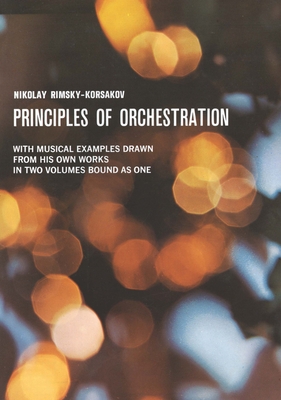
“To orchestrate is to create, and this cannot be taught,” wrote Nikolay Rimsky-Korsakov, the great Russian composer whose genius for brilliant, highly colored orchestration is unsurpassed. But invention, in all art, is closely allied to technique, and technique can be taught. This book, therefore, which differs from most other texts on the subject because of its tremendous wealth of musical examples and its systematic arrangement of material according to each constituent of the orchestra, will undoubtedly be of value to any music student. It is a music classic, perhaps the only book on classical orchestration written by a major composer.
In it, the composer aims to provide the reader with the fundamental principles of modern orchestration from the standpoint of brilliance and imagination, and he devotes considerable space to the study of tonal resonance and orchestral combination. In his course, he demonstrates such things as how to produce a good-sounding chord of certain tone-quality, uniformly distributed; how to detach a melody from its harmonic setting; correct progression of parts; and other similar problems.
The first chapter is a general review of orchestral groups, with an instrument-by-instrument breakdown and material on such technical questions as fingering, range, emission of sound, etc. There follows two chapters on melody and harmony in strings, winds, brasses, and combined groups. Chapter IV, Composition of the Orchestra, covers different ways of orchestrating the same music; effects that can be achieved with full tutti; tutti in winds, tutti pizzicato, soli in the strings, etc.; chords; progressions; and so on. The last two chapters deal with opera and include discussion of solo and choral accompaniment, instruments on stage or in the wings, technical terms, soloists (range, register, vocalization, vowels, etc.), voices in combination, and choral singing.
Immediately following this text are some 330 pages of musical examples drawn from “Sheherazade,” the “Antar Symphony,” “Capriccio Espagnol,” “Sadko,” “Ivan the Terrible,” “Le Coq d’Or,” “Mlada,” “The Tsar’s Bride,” and others of Rimsky-Korsakov’s works. These excerpts are all referred to in the text itself, where they illustrate, far better than words, particular points of theory and actual musical practice. They are largely responsible for making this book the very special (and very useful) publication it is.
This single-volume edition also includes a brief preface by the editor and extracts from Rimsky-Korsakov’s 1891 draft and final versions of his own preface, as well as an appendixed chart of single tutti chords in the composer’s works.
Author: Nikolai Rimsky-Korsakov
Binding Type: Paperback
Publisher: Dover Publications
Published: 06/01/1964
Series: Dover Books on Music
Pages: 512
Weight: 1.5lbs
Size: 9.20h x 6.50w x 1.00d
ISBN: 9780486212661
Language: English
This title is not returnable




Reviews
There are no reviews yet.